Big day today. Big sleep tonight.
Faces, friends, hot shoppers, lots of artists showing wares.
South Side Art Market really draws a crowd.
And fun.
Thursday, August 24, 2017
Tuesday, May 20, 2014
Looks like the One Man Art Show is a goer. So took the birds for a fly on a recent trip to Sydney. Bondi Beach. The bird is a Western Spinebill from West Coast Australia so it seemed appropriate to house him with local flora – namely a rareish Black Kangaroo Paw with Blue Lechenaultia, and Lamb's tail.
Putting it together
Desktop space is invariably crowded with bits and pieces. 'Works in progress'. This one is particularly tough to figure out. What to do? The guy in the boat (me) was drawn in 199?. The Jesus Bird came next. The croc was last year. The giant lotus and leaf are today. All memories of the Kakadu visit in the mid 90s when the head guy had me towed solo, on to Yellow Waters in a small tinny to await sunrise and photograph Giant Red Lotus openings. The mind played tricks about crocodiles but scuffles turned out to be Lily Walkers. The assignment was for Ita Buttrose and made in the company of writer Patsy Hollis. Now, just how do you bring all that into one picture. Beats me.Monday, January 20, 2014
Tuesday, December 10, 2013
Vanda Miss Joaquim orchid
Vanda Miss Joaquim orchid, originally uploaded by manful.
Late 19th Century one Agnes Joaquim discovered a new orchid growing in her Singapore garden – a natural hybrid (or so she claimed) between two lovely species, Malayan Vanda hookeriana and the Burmese Vanda teres. The lady was an avid gardener so truth be told she probably gave nature a little prod along. But never let truth get in the way of a good story.
Thus was born the beautiful Singapore Orchid, Vanda Miss Joaquim, finally crowned in 1981 as the national flower of Singapore. What an achievement.
V. Miss Joaquim is a rampant, rather rangy lady and great stands of the orchid flourish in the Singapore Botanic Gardens at two and three metres height, but there is a delicacy to the flower itself. This, the first showing in my new orchid space, feels a bit yellowy to me, but time will tell. It’s just lovely to find the lady flourising here in Brisbane suburbia, so far from home. A world traveller.
Saturday, November 2, 2013
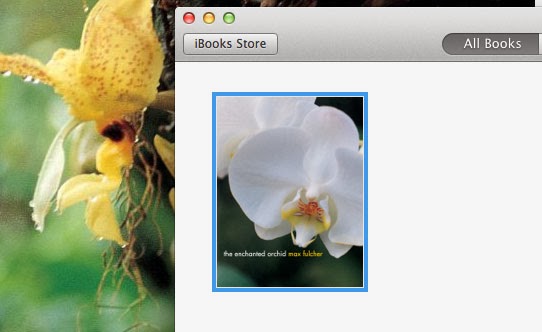
With the latest (free) Apple update Apple Mac operators are AT LAST able to view my book 'The Enchanted Orchid' right on the DESKTOP. Apologies for going a bit commercial and sorry that the download from iTunes will cost you about 10 bucks but it IS a good read and the photography reproduction is devastatingly good. Even if you are not into orchids it could be a great way of solving Christmas gift giving if you have orchid mates with a Mac.
Monday, October 21, 2013
Friday, October 11, 2013
Wednesday, October 2, 2013
Indian orchid, Australian hoya
Indian orchid – Australian hoya
Worked right through the night on this one. Wanted to catch it while the bloom was still on the plant. Back to bed. Oh well, there goes Tuesday. Not sure if it's missing something. Probably a bird or two. Shall find out when I take it over to the printers later this week to see the final, in hand – adjustment is a breeze on the Mac. Set against a golden cane palm, the orchid is Dendrobium pierardii and the hoya (Hoya nicholsoniae) is from northern parts of Queensland, Paupa New Guinea, and the Solomon Islands.
Thursday, September 19, 2013
Sunbird, Dendroium densiflorum
Via Flickr:
Tiny nectar eating Sunbirds and cadium coloured Dendrobium orchids share like climates. The Olive-backed Sunbird found in northern parts of Australia is a small nectar-eating member of an enormous and even more colourful family that reaches into South East Asia, the Indian subcontinent and right across Africa. The orchid (Dendrobium densiflorum) universally described as 'one of the Indian Dendrobiums' flourishes in temperate to sub-and-tropical zones worldwide. The idea of illustrating them together began way back in 2010 in stops and starts, when I grew 'Indian' orchids in profusion in the Noosa hinterland. Yesterday, in a rush of hours and well into the evening the subject s finally came together. A sunshine thought to welcome spring.
Tuesday, May 7, 2013
Palm Cockatoo in Pandanus
You must travel to Far North Queensland, New Guinea, and parts of Indonesia to see these incredible birds in home territory. It's worth the effort because your encounter with Palm Cockatoos is never forgotten. A powerful vocal range, from ear shattering call to incessant sweet chatter, almost convinces the bird is speaking to you. Top-heavy headgear and an massive wingspan in flight are all part of the heart-stopping moment.
Once, just once, in FNQ I shared this marvellous experience. Just out of camera reach the pair became a series of quick diary sketches. Not as shiny black as, say, crows and ravens, the birds appeared to have a sooty, charcoal colour. But how do you capture nature in a mere illustration. I chose to place them in Pandanus, whose fruit and nuts are hardly competition for such impressive beaks.
Sunday, April 7, 2013
maxful's photostream
maxful's photostream on Flickr.
My attempt to render a pair of male Birds of Paradise dancing for their lady's attention is prompted by a stunning film clip bit.ly/ZI3hjz by Tim Laman and Ed Scholes. The men journeyed for a decade into New Guinea and the exotic world of birds-of-paradise. Much has been documented on the dazzling courtship antics of the male birds, not a lot on the female. As I have not observed these amazing birds in their natural habitat it may have been unwise to imagine them in a surround of native Lilly Pilly. Though a fruit-eating species, I suspect these lovely creatures live in dense and deep-dark tropical rainforest. The Syzygium oleosum is from the Noosa area in South East Queensland.
Subscribe to:
Posts (Atom)